by Yashar Moradi
Introduction
The construction industry has traditionally operated with rigid, waterfall-style project management models, where deviations from the plan often result in delays, cost overruns, and inefficiencies. While this approach has long been the norm, today’s projects demand greater flexibility, collaboration, and adaptability.
Agile methodologies—rooted in manufacturing, refined through empirical process control, and perfected in the software industry—offer a way to rethink how construction projects are managed. By focusing on iteration, collaboration, and continuous improvement, Agile principles can revolutionize construction, just as they have transformed other industries.
The Origins of Agile
Agile’s roots lie in lean manufacturing, specifically in practices like the Toyota Production System, which emphasized waste reduction, efficient workflows, and continuous improvement. Central to this approach was Empirical Process Control—a framework for managing complex systems based on three pillars:
Transparency: Ensuring all stakeholders have a clear view of the process and its progress.
Inspection: Regularly reviewing work to identify issues early.
Adaptation: Adjusting plans and processes in response to feedback and changing conditions.
These principles were later adapted by the software industry to manage the complexities of iterative development. Frameworks like Scrum and Kanban emerged, formalizing Agile practices and demonstrating their power to handle dynamic and unpredictable environments.
“In the waterfall model, everything happens in sequence, leaving little room for change. Agile, by contrast, embraces complexity and iteration, making it perfect for today’s dynamic industries.” – Adapted from Agile Alliance
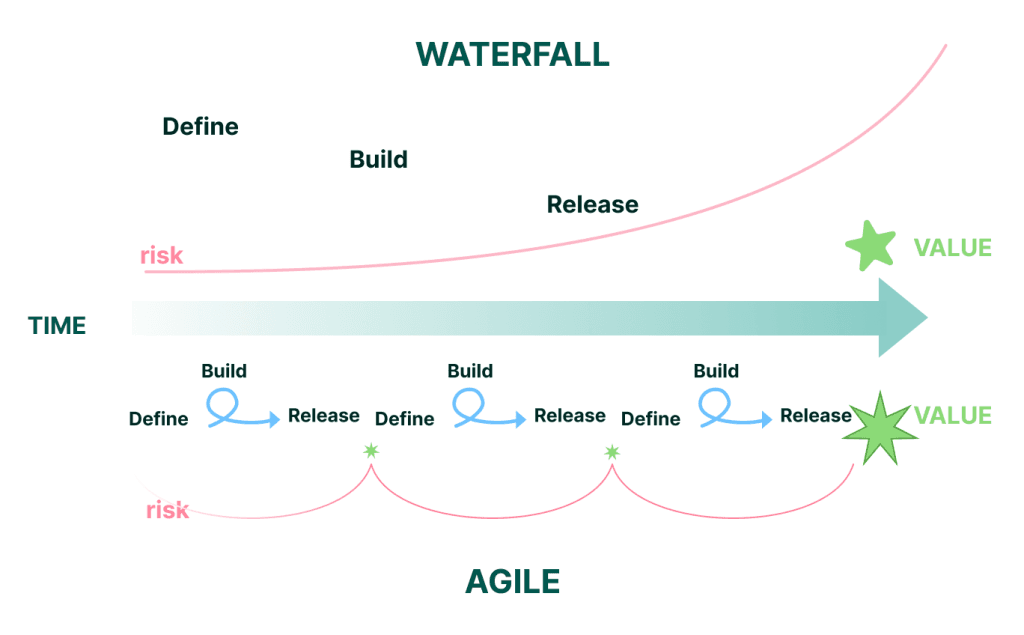
Comparison of Waterfall vs. Agile Project Management Models (source: Gantt Pro)
Challenges in Traditional Construction Management
The construction industry has largely relied on sequential, waterfall-style workflows like Design-Bid-Build (DBB), which often result in:
Inflexibility: Changes mid-project lead to delays and cost escalations.
Siloed Communication: Architects, contractors, and owners work independently, leading to misalignment.
Missed Opportunities: Limited feedback loops prevent learning and improvement during project execution.
These issues make traditional methods poorly suited to the increasing complexity and speed required in modern construction projects.
Applying Agile Principles to Construction
Agile offers a powerful alternative by introducing iterative, collaborative, and adaptive practices. Here’s how construction can adopt these principles:
Iterative Progress with Transparency
Break projects into smaller, manageable phases, allowing for incremental delivery and regular reassessments.
Use tools like Building Information Modeling (BIM) to maintain transparency across stakeholders.
Continuous Feedback and Collaboration
Engage stakeholders—owners, architects, and contractors—throughout the process to ensure alignment and address issues promptly.
Conduct regular review meetings (similar to Scrum sprints) to gather insights and improve workflows.
Adaptation through Flexibility
Allow design and execution to evolve based on feedback, reducing the risk of costly rework.
Incorporate prefabrication into workflows to enable modular adjustments without compromising timelines.
Empirical Process Control in Action
Transparency: Provide clear, real-time data on project status using collaborative platforms.
Inspection: Perform regular quality checks on both on-site and prefabricated components.
Adaptation: Adjust plans dynamically based on project feedback, improving outcomes iteratively.
Case Studies: Agile in Action
While Agile is still emerging in construction, some projects have successfully integrated its principles:
Hospital Interior Fit-Outs: A U.S.-based hospital adopted Agile sprints to complete interior work, adapting quickly to changing client needs without impacting the overall schedule.
Modular Housing Projects: Prefabrication firms use iterative design and construction cycles to ensure high-quality, scalable housing solutions, while accommodating customization.
These examples highlight how Agile’s adaptability and collaborative focus can lead to better outcomes.
Benefits of Agile in Construction
Adopting Agile methodologies offers numerous advantages:
Flexibility: Projects can adapt to changes without derailing timelines or budgets.
Collaboration: Enhanced communication ensures alignment and reduces conflicts.
Quality Assurance: Iterative reviews catch issues early, minimizing defects and rework.
Efficiency Gains: Overlapping design and construction phases streamline project delivery.
Challenges of Implementing Agile in Construction
As promising as Agile is, adopting it in construction is not without challenges:
Cultural Resistance: Teams accustomed to traditional methods may be hesitant to change.
Training Needs: Stakeholders must learn Agile principles and adapt workflows accordingly.
Complex Contracts: Current construction contracts often lack the flexibility needed for Agile practices.
However, these hurdles can be overcome through strong leadership, clear communication, and investments in training and digital tools.
Conclusion
Agile methodologies, rooted in empirical process control and honed by the tech industry, offer construction a roadmap for managing complexity and uncertainty. By embracing iterative progress, collaboration, and adaptability, construction teams can deliver better outcomes faster and more efficiently.
The shift requires effort—a rethinking of contracts, workflows, and even mindsets—but the rewards are transformative. Agile can bring the construction industry into the 21st century, delivering not just projects but value. It’s time to make the construction site as dynamic and adaptable as the world it helps build.
References
Toyota Production System - Lean manufacturing principles: Toyota’s Lean Methods
Agile in Software - History of Agile and the Agile Manifesto: Agile Alliance
Agile Construction Examples - Adopting Agile in construction: PlanRadar Blog
Empirical Process Control - Core principles of Agile: Scrum.org
Recent Posts


Prefab intelligence for real-estate developers
Andreasstr. 5. 8050 Zurich, Switzerland
Geisenhausenerstr. 17, 81379 Munich, Germany
info@mod.construction
CH: +41 445056 100
DE: +49 158 8865 2002